
 Facebook
 Twitter (X)
 LinkedIn
 Instagram
 Youtube

B Braun Exec Joins Board
The Board of Directors of Community Services for Children recently welcomed Christopher P. Donigan to the Board for a three-year term. Mr. Donigan is the Executive Vice President of Human Resources at B. Braun Medical, Inc. in Bethlehem, PA. Prior to coming to B. Braun, Donigan worked for Nationwide Insurance, Liberty Ridge Capital and Bristol-Myers Squibb.
Donigan earned his MBA from the University of North Dakota and a B.S. in Business Administration from Duquesne University. He is a Captain with the United States Air Force. He also serves as the secretary on the Board for Habitat for Humanity of the Lehigh Valley, Member of the Business Education Partnership Committee of the Workforce Investment Board and Moravian College President’s Advisory Board. He volunteers with the VIA Marathon and Boy Scouts of America.
January 29th, 2016
Posted In:
Carole Koepke Brown: Program for Young Children Aims to Give Them a Safe Start
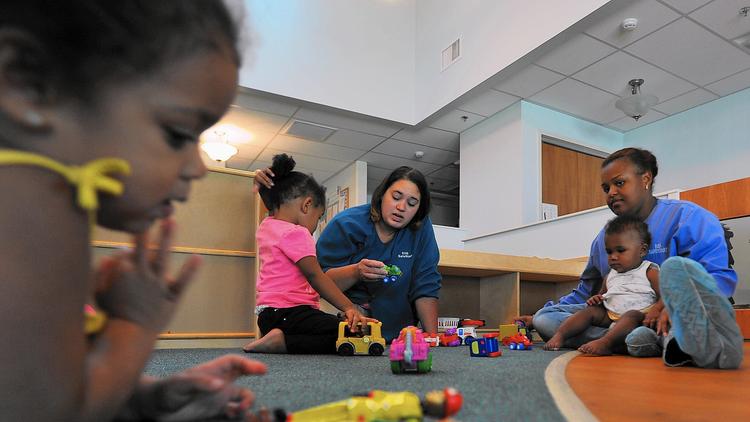
Therapist teachers work with toddlers in the Safe Start program at Community Services for Chilldren in Allentown in 2012. (APRIL BARTHOLOMEW / MORNING CALL File Photo)
Under the umbrella of Community Services for Children, the program Safe Start is thriving. Designed by Paula Margraf, executive vice president for Community Services, it strategically provides therapeutic child care all year round to children whose caregivers are living below the poverty line. These children were exposed to drugs and/or alcohol prenatally. They were referred to Safe Start by children and youth services because they have open cases due to abuse or neglect. A two-generation program, Safe Start includes the caregivers of these youngsters. The adults are regularly invited to the Donley Family Center for Infants at the Community Services for Children campus in east Allentown to form a group, to share their lives, to learn about ways to cope with stress, and to have fun together.
When I feel rattled by reports of ISIS, I feel my spirits drop. My whole body feels weak. For respite, I return in my mind’s eye to the Fridays I spent volunteering at Safe Start in the building built from the ground up to address the needs of 40 small youngsters. Again and again when I would walk down the long main corridor (on the walls hang elegant hand-made quilts by a former staff member), I would say inside: This is how life should be. This is how life should be.
One day in Safe Start I was holding a drug-affected infant who was crying hard. I tried to calm the little one. I failed. Then I watched a staff member who took over. Her rocking tempo was faster than mine, and the entire time she sang softly, soothing the baby. Next time I held a distressed baby, I imitated what she had done. It worked.
In his Your View, Walker cites the Nobel Prize-winning economist James J. Heckman. Bessel van der Kolk’s exceptional “The Body Keeps the Score: Brain, Mind, and Body in the Healing of Trauma” has strong praise for Heckman and for programs like Safe Start.
As van der Kolk summarizes the takeaway lesson, “Vast savings [are] produced by early intervention in the lives of children from poor and troubled families: more high school graduations, less criminality, increased employment, and decreased family and community violence.” Even though it costs about $35,000 for one child to be enrolled in Safe Start for one year, it is smart economics — if the long view is taken.
In addition to the 40 children at the Donley Center, 32 infants are being served by home visits. Their site at 17th and Chew streets, Allentown, will open early in 2016. Safe Start began in 2003 with seven babies.
I sought for a visual emblem to capture Safe Start’s development. Recently I was on the top floor of the building at Center and Elizabeth streets in Bethlehem. From there I looked south, down on the Moravian College football field. I now imaginatively revisit that view that has become my image: seven infants on the field, each held by a Safe Start caregiver, with one pair on the 50-yard line, a pair on each of the 40-yard lines, a pair on each of the 30-yard lines, and a pair on each of the 20-yard lines. This 2003 scenario represents the seven infants in the program at its outset.
Then I close my eyes and open them for the current, expanded view: each one of these same yard lines now has 10 pairs (an infant or toddler with a caregiver). Thus far, there are 70, so I add a pair on each 10-yard line, because Safe Start is currently serving 72. From 2003 to 2015 — from seven to 72. That’s much to be thankful for, indeed.
Long may you thrive, Michael Walker and every staff person at Community Services for Children.
Carole Koepke Brown of Bethlehem is an associate professor of English, emerita, at Moravian College.
View the original article on The Morning Call.
Copyright © 2015, The Morning Call
3S33d_admin December 1st, 2015
Posted In:
A FOCUS Special Report on the PA Budget Stalemate
FOCUS Season 3 Episode 9: PA State Budget
A FOCUS Special Report on the PA budget stalemate. With a funding plan overdue 1140 days and counting, senior centers, emergency shelters and pre-school programs across the state cut services. With Team coverage we show you how schools and social service agencies in our region cope without thousands, and in some cases, millions of dollars in state funding. Hear from stakeholders with programs riding on the impasse in Harrisburg.
3S33d_admin November 23rd, 2015
Posted In:
Boston Shows Quality, Not Tennessee
Tennessee recently released a study showing that its state-subsidized pre-k made no difference in child achievement by the end of kindergarten between those who had the program and those who didn’t. Yet a recent report from Boston showed the opposite. In fact, achievement gains were evident through third grade.
What’s the difference between Tennessee and Boston? Quality. In Tennessee, each teacher developed her own curriculum and her own methods. There was no teacher preparation. Contrariwise, in Boston, teachers were taught child development, received abundant coaching from veteran teachers, and used standard curriculum and a hands’ on, experiential approach. Similar results have been found in New Jersey, North Carolina, Michigan, Oklahoma and Illinois.
Economists estimate that for every dollar invested in high quality pre-k, $7.10 is generated in savings down the road. Well-educated, experienced teachers, small classes and coaching all contribute to higher quality.
November 2nd, 2015
Posted In:
Early Education Simply Good Business
The measure by which we judge which investments are worthwhile as a citizenry is how much time we spend, energy we expel, and the amount of resources we dedicate in the hope of future benefits. It should be axiomatic that investment in early childhood education is sound policy and will yield far reaching economic returns. Unfortunately our underfunded preschool programs and the limited resources provided to early childhood education say otherwise.
Leading research suggests that early education investments are simply good business. Nobel Prize-winner and famed economist James Heckman has shown that investments in high-quality early childhood education have returns of seven to ten percent for every dollar spent. Art Rolnick and Rob Grunewald of the Minneapolis Federal Reserve Bank published a paper comparing education investments to other state investments and concluded that early education investments yield a return that far exceeds the return on most public economic development projects.
This research isn’t lost on the rest of the world. According to the Organisation for Economic Co-operation and Development (OECD), Japan enrolls nearly all of its 4 –year- olds in preschool. Just a decade ago the United Kingdom pledged to provide universal preschool to every child between the ages of 3 and 5 and now enrolls at least 97 percent of its 4- year- olds in preschool. The National Institute for Early Education Research wrote that for the 2012-2013 school year, US pre-K enrollment was at 28 percent for 4 year-olds across all states. Research further revealed that if enrollment growth remains stagnated at its current rate, it would take 75 years for states to reach 50 percent enrollment for 4-year-olds, and 150 years to reach 70 percent enrollment. In contrast, by 2020, China will increase preschool enrollment by 50 percent, providing access to over 70% of its children; and by 2018, India will raise the percent of children who are ready for school from 26 to 60.
The US simply doesn’t invest enough in early childhood education. In fact, as a percentage of the GDP, the United States invests 0.4 percent of our GDP in preschool. In comparison, China spend 3.28 percent of their GDP on preschool, while smaller countries like Denmark, Spain, and Israel each spend 0.9 percent. OECD also found that the United States ranks behind most of the other countries in global ranking. Comparing the top 39 most affluent countries, the US is 26th in preschool participation of 4 year olds, 24th in preschool participation for 3 year olds, and 21st in total investment in early childhood education relative to country wealth.
These numbers are important because countries like Japan for instance outperformed the United States by more than 40 points on the most recent international test for fourth grade math. These numbers are of particular importance when we look at the local impact. The new PSSA test for Pennsylvania revealed an across the board drop in proficiency standards. Opponents of the new common core based PSSA test surmised that the test is not a good indicator of future successes in education but certainly those numbers tell some of the story. The common core standards have roots in international educational best practices and what we have found is when we invest early the returns are profound.
Against that backdrop the silence in Harrisburg is deafening as the Commonwealth sits embroiled in a budget impasse. Likewise, the Federal Government continues to kick the can down the road with continuing resolutions on appropriations. School districts and those not for profit agencies serving children collectively wonder aloud whether we will invest our time, expel our energy and invest our resources in what should be self evident- that investment in early education is simply good business.
Editorial by Michael A. Walker, Esq, CEO/President of CSC
Appeared in the Morning Call October 11, 2015
November 2nd, 2015
Posted In:
EHS program for abused babies expands
With major funding by the US Department of Health & Human Services currently available for expanding Early Head Start services across the country, Community Services for Children (CSC), Children’s Hospital at Lehigh Valley Hospital, and Lehigh County Children and Youth Services are working together to expand CSC’s Early Head Start center-based program. The program supports babies and toddlers who are at high risk of experiencing developmental challenges due to the adverse effects of being exposed to drugs and/or alcohol prenatally in addition to potential abuse or neglect.
CSC’s Early Head Start center-based program, called SafeStart, has been in operation since 2003 in Allentown’s east side on the Donley Children’s Campus. The SafeStart program is the only one of its kind in Pennsylvania.
SafeStart helps these young children achieve health and wellness through rigorous therapeutic intervention five days a week, year round. At age 3, most transfer into a Head Start classroom for an additional two years of early intervention. Twelve years of data indicate that 85% achieve growth and development milestones typical for their age and 75% are symptom-free of the effects of drugs and alcohol. This two-generation program also helps parents or other care givers achieve stability in their lives and the ability to nurture a healthy child. With healthy outcomes, the cost to schools and social agencies is radically reduced.
The first location is able to serve 40 children, and this expansion will open a second site for an additional 32 children. The expansion, which is currently in development and being implemented as a home visiting program, is being outfitted for their classroom space and will become an open center-based classroom in the winter of 2015-16. The renovations include the creation of 4 classrooms in the former School of Nursing building at LVH- 17th Street in Allentown.
Under an agreement with LVHN, the program is also supported by funding from the US Dept of Health & Human Services and Lehigh County Children & Youth. At the east side location, Northampton County Children & Youth also help support the program along with Lehigh County, the federal government, and private grants/donations.
“As a children’s hospital we are equipped to provide specialized care to the region’s sickest children,” said J. Nathan Hagstrom, MD, chair, pediatrics. “Yet we also have the desire to create health in the hopes that fewer children will end up in the hospital. Working with partners like CSC we learn how to more effectively help these children to be as healthy as they can be.”
In 2013, LVHN pediatric residents began an educational rotation with SafeStart children and families at their east side location. This educational program will continue in coming years at LVH-17th Street.
October 30th, 2015
Posted In:
Head Start Director heads to UCLA
Pamela Bratspies Cho, Director of Child Development Services for Head Start of the Lehigh Valley, was recently selected through a national competitive application process to attend an intense two-week UCLA/Johnson & Johnson Head Start Management Fellows Program in Los Angeles.
The Head Start – Johnson & Johnson Management Fellows Program provides a unique opportunity for Head Start administrators to build their executive and entrepreneurial management skills. Eighty hours of classroom instruction, case studies, workshops and group discussions will cover human resource management, organization design and development, finance, data analysis, operations management and marketing.
Cho is a 7-year veteran of Head Start/Early Head Start with a 25-year career in social work and children’s services. She previously earned a Master’s of Social Work from the University Pennsylvania. Before her tenure with Head Start/Early Head Start, she was the director of placement services with Pinebrook Services.
Paula Margraf, Executive Vice President and Director of Head Start/Early Head Start of the Lehigh Valley, was previously selected as a fellow in the program as was Rebecca Fenerty, Director of Head Start Operations and Family Services.
Community Services for Children, which administers Head Start of the Lehigh Valley, provides quality early childhood education and related service affecting 40,000 children annually in 18 counties of Pennsylvania.
3S33d_admin May 7th, 2015
Posted In:
Ervin Awarded Champion of Children
The Pennsylvania Early Learning Investment Commission (ELIC) recognized Jane Ervin, CEO/President of Community Services for Children, with its Champion of Children Award at its April 15th annual conference in Harrisburg. The Champion of Children Award is given each year in recognition of someone who has supported investment in early childhood education by increasing awareness, encouraging advocacy, and acting on behalf of children and their families. The first Champion of Children Award was given to Mr. Edward Donley in 2013.
Ervin is known statewide for her enormous contributions to children in the Lehigh Valley. She has devoted much of her time to ensuring that Lehigh and Northampton County children have access to high-quality early learning. She has worn many hats in her roles as CEO of Community Services for Children, Lehigh County Executive, Lehigh County Commissioner and on the boards of directors for the United Way of the Greater Lehigh Valley, Lehigh Valley Children’s Coalition, and Pennsylvania Partnerships for Children. She has also helped to coordinate and lead the Lehigh Valley Early Learning Coalition, helping them progress form awareness and advocacy to action.
3S33d_admin April 21st, 2015
Posted In:
Head Start LV Earns Top Ranking
Community Services for Children’s Head Start/Early Head Start of the Lehigh Valley is the newest “Program of Excellence” designee recognized by the National Head Start Association (NHSA). This designation is earned only by the top performers and leaders in Head Start and Early Head Start. These programs consistently demonstrate excellence in program management and service performance, exemplify best practices and develop innovative techniques for addressing vital issues in Head Start and Early Head Start.
Head Start of the Lehigh Valley is the first program to earn this distinction in the mid-Atlantic and Northeastern US. There are only 10 other such programs nationwide out of 1000 Head Start organizations.
Head Start of the Lehigh Valley is celebrating 50 years in 2015, having started as a summer program in Easton in 1965. Today, the program enrolls 1220 children across the Lehigh Valley, prenatal to age 5. Head Start/Early Head Start prepares the poorest children to succeed in kindergarten and engages parents to support their child’s learning.
3S33d_admin March 13th, 2015
Posted In:
Weis Markets donates $5K for Innovative Literacy Lab
Community Services for Children (CSC) recently received $5,000 from Weis Markets in Educational Improvement Tax Credit (EITC) funding in support of its innovative Literacy Lab program.
“We are so appreciative of Weis Market’s community support. This is the building block for successful high school graduation and an educated workforce,” said Jane Ervin, chief executive officer and president of CSC.
The innovative Literacy Lab program for preschoolers enrolled in CSC’s Head Start program has proven to accelerate young children’s grasp of early literacy skills, which can help future success with language, reading and writing. Children enrolled in Head Start live in households with incomes at or below the poverty line. Head Start, celebrating its 50th anniversary in the Lehigh Valley this year, has helped more than 30,000 children achieve early success in school.
CSC is approved by the Pennsylvania Department of Community and Economic Development as an Educational Innovation Organization and a Pre-Kindergarten Scholarship Organization. Qualifying businesses may receive tax credits in exchange for donations to CSC to fund students from low income families attending high quality pre-K programs. These credits are obtained through the program Educational Investment Tax Credits (EITC) and administered by the Pennsylvania Department of Community and Economic Development.
CSC is the region’s leader in early childhood education and family development, reaching 40,000 children in 18 counties annually. For further information, call Sara George, 610-437-6000, x2101.
3S33d_admin February 26th, 2015
Posted In: